 I used to think my life was over.
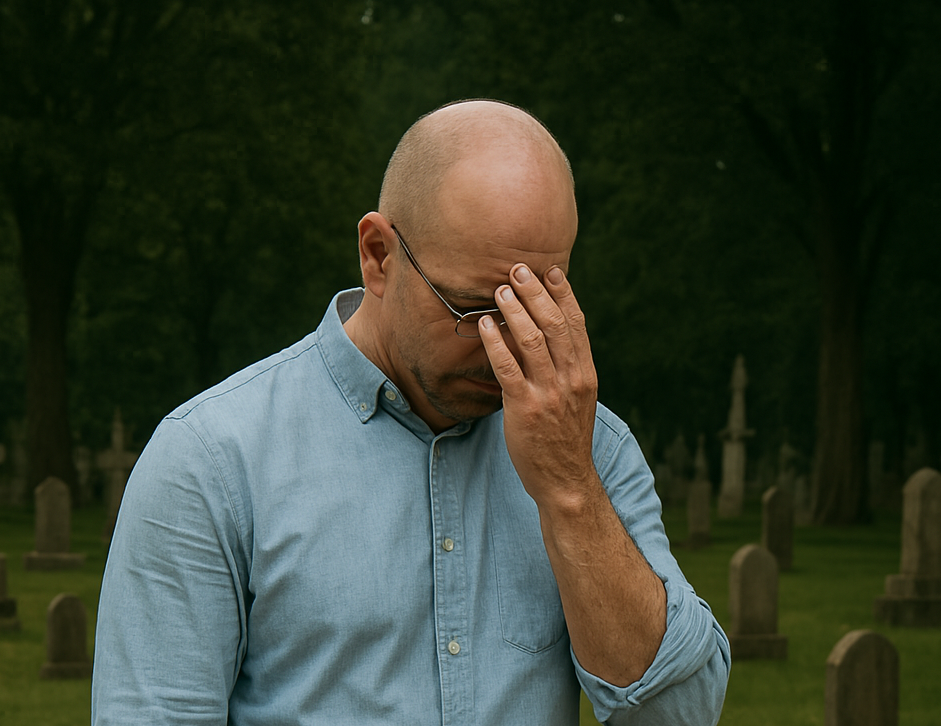
When my marriage fell apart, it didn’t just break my heart—it shattered my sense of identity. I wasn’t just a man who had gone through a divorce. I was, in my own mind, a failed Christian man, a walking contradiction to everything I thought I was called to be. I lost my home. I lost the rhythm of daily family life. I lost the script I had clung to—the one where I was supposed to be the husband, the protector, the provider, the spiritual anchor.
Instead, I felt like a statistic. Another man who didn’t make it. Another broken family. Another hollow echo in the church foyer when people asked, “How are things?”
I carried shame like a weight around my neck. I replayed every failure. I internalized every judgment. And beneath it all was a whisper I couldn’t silence:
I used to think my life was over.
When my marriage fell apart, it didn’t just break my heart—it shattered my sense of identity. I wasn’t just a man who had gone through a divorce. I was, in my own mind, a failed Christian man, a walking contradiction to everything I thought I was called to be. I lost my home. I lost the rhythm of daily family life. I lost the script I had clung to—the one where I was supposed to be the husband, the protector, the provider, the spiritual anchor.
Instead, I felt like a statistic. Another man who didn’t make it. Another broken family. Another hollow echo in the church foyer when people asked, “How are things?”
I carried shame like a weight around my neck. I replayed every failure. I internalized every judgment. And beneath it all was a whisper I couldn’t silence:
“You are a failure.”For a long time, I believed that. I believed I was stuck. That this was it—my life had peaked and crumbled, and now I was just surviving. Not rebuilding. Not becoming. Just surviving. But something surprising happened in the quiet aftermath. Pain, as it turns out, has a strange power to strip away illusions—not just about others, but about ourselves. I started to see myself clearly—not as a hero, not as a failure, but as a man. A man who had loved and lost, who had made mistakes, who had learned the hard way that being right is not the same as being wise. That good intentions can’t replace emotional maturity. That trying harder isn’t always the answer—sometimes, it’s letting go. The more I grieved, the more I grew.
The more I reflected, the more I reframed. I used to think that heartbreak disqualified me. Now I see it qualified me in ways comfort never could. I’m not the same man who stood at the altar the first time.
I’m older. Yes. But also—wiser.
I know now what not to do. I know the weight of silence, the power of listening, the danger of pride.
I know that forgiveness isn’t just a Christian concept—it’s a survival skill.
I know that leadership in a marriage means serving when it hurts, and that presence matters more than perfection. And now?
Now I see that I’m becoming the kind of man I never thought I could be.
Not because I avoided failure, but because I let failure teach me. I am a more thoughtful father.
A more grounded partner.
A more compassionate human being.
And far from being disqualified by my past, I’ve discovered that the cracks in my story are the places where God planted wisdom I could never have found on my own. So no, I’m not a statistic.
I’m a story in progress.
And if you’re reading this and carrying your own shame, hear me:
You are not stuck.
You are not disqualified.
You are not what happened to you. You are who you become through it. Scripture tells us, “As a man thinks in his heart, so is he” (Proverbs 23:7). Neuroscience tells us something eerily similar: your strongest thoughts become the architecture of your brain. Every thought leaves a trail—chemical, emotional, spiritual. You’re not just reacting to the world; you’re building the world you live in, from the inside out.
The Lies That You did Not Know You Believed
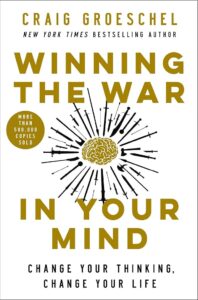 I strongly recommend Winning the War in Your Mind by Craig Groeschel on this issue.
Think of a circus elephant. When it’s small, they tie a rope to its leg and anchor it to a heavy stake. The baby elephant pulls and strains but cannot break free. Eventually, it stops trying. Years later, when it has become a massive, powerful creature, the trainer doesn’t need chains—just a thin rope. The elephant could break free with ease… but it doesn’t. Why?
Because it believes it can’t.
And that’s the power of a lie.
You may be carrying a rope like that.
A thought you didn’t choose, but you’ve repeated long enough that it feels like reality.
– “I’ll never be good with money.”
– “Every relationship falls apart.”
– “I’m not lovable.”
– “God might love people… but not me.”
These aren’t just limiting beliefs. In biblical language, they are strongholds—mental fortresses of deception that hold you captive. And they don’t just exist in your mind. They shape your future.
But here’s the hope:
You can take them captive.
The apostle Paul says in 2 Corinthians 10:5, “We take captive every thought to make it obedient to Christ.”
Not some thoughts.
Every thought.
This is not passive faith. This is warfare.
Let me explain how this will really change your life!
I strongly recommend Winning the War in Your Mind by Craig Groeschel on this issue.
Think of a circus elephant. When it’s small, they tie a rope to its leg and anchor it to a heavy stake. The baby elephant pulls and strains but cannot break free. Eventually, it stops trying. Years later, when it has become a massive, powerful creature, the trainer doesn’t need chains—just a thin rope. The elephant could break free with ease… but it doesn’t. Why?
Because it believes it can’t.
And that’s the power of a lie.
You may be carrying a rope like that.
A thought you didn’t choose, but you’ve repeated long enough that it feels like reality.
– “I’ll never be good with money.”
– “Every relationship falls apart.”
– “I’m not lovable.”
– “God might love people… but not me.”
These aren’t just limiting beliefs. In biblical language, they are strongholds—mental fortresses of deception that hold you captive. And they don’t just exist in your mind. They shape your future.
But here’s the hope:
You can take them captive.
The apostle Paul says in 2 Corinthians 10:5, “We take captive every thought to make it obedient to Christ.”
Not some thoughts.
Every thought.
This is not passive faith. This is warfare.
Let me explain how this will really change your life!
The Strongholds on Your Soul
It often starts young. A failure. A wound. A moment of shame. You touched the stove and got burned—so now you avoid all fire. You tried. You failed. And somewhere deep inside, a whisper took root:“Don’t try again. You’re not that kind of person.”That’s not just a thought. That’s a script. And like any script, it needs to be re-written. Modern psychology confirms what Scripture declared long ago: our lives follow the trajectory of our thoughts. And thoughts, if left unchallenged, become identities. You’re not just “having a bad day” anymore. Now, you’re a failure. You’re unlovable. You’re cursed. And worst of all—you might think that’s just how things are. But that’s not how things have to be.
How to Make Real Change
Craig Groeschel lists four principles: The book introduces four principles: Replacement, Rewire, Reframe, and Rejoice, each offering a strategy to combat negative thinking. I have my own twist on these below for you. Let’s get practical. If you want to change your life, you must first confront the lies. Here’s a path forward, not from pop-psychology, but from soul-level wisdom:We wake up exhausted, anxious, ashamed. We scroll through social media comparing ourselves to everyone else’s highlight reel. We avoid risks, conversations, and commitments not because we can’t—but because somewhere deep inside, we’ve already decided we’re not enough. That’s not a personality quirk. That’s a mental stronghold. And strongholds don’t fall by accident. If you feel stuck—spiritually, emotionally, relationally—this might be why. So how do you break free from the thoughts that are breaking you?
Not with trendy affirmations or self-help fluff. But with a path forged from soul-level truth. Let me walk you through it.
1. Recognize the Stronghold You can’t fight what you won’t face. Every self-sabotaging behavior—procrastination, addiction, perfectionism, hiding—is a symptom of a deeper belief. The real enemy isn’t what you’re doing. It’s what you’re believing. So ask yourself:
What’s the lie behind the stress?
What’s the story running in the background? – “I’ll never be good enough.”
– “People always leave.”
– “It’s too late for me.”
– “I’m a fraud and someone’s going to find out.” Don’t judge it. Just name it.
Because what remains hidden stays powerful.
But what’s brought into the light can be transformed.
2. Restore Truth to Its Rightful Place The world will sell you slogans: “Just be you.” “You got this.” “Follow your truth.”
But your soul isn’t looking for slogans. It’s longing for something deeper.
Truth that holds when life breaks down. That truth doesn’t come from within. It comes from above. – “You are fearfully and wonderfully made.”
– “Nothing can separate you from the love of God.”
– “If anyone is in Christ, he is a new creation.” You don’t have to invent your worth.
You have to remember it.
Truth doesn’t need to be made up. It needs to be restored.
3. Reframe the Narrative Here’s the mistake most of us make: we think our past defines our limits.
But what if it defines your calling instead? – That failure? Not a verdict. A classroom.
– That heartbreak? Not a disqualifier. A refining fire.
– That weakness? Not your identity. The starting place of strength. You can’t rewrite your history.
But you can reframe what it means. Tell a better story about who you are—one that includes your scars, but doesn’t end with them. You are not the product of your pain.
You are the person emerging from it.
4. Rebuild Your Reinforcements You were never meant to win this war alone. Some of the most dangerous people in your life are the ones who affirm your fear.
They tell you what you want to hear—not what you need to hear. Find truth-tellers.
People who call you higher, who challenge your narrative, who remind you of who you are when you forget. Your environment is shaping your identity.
If you want to think differently, live around people who think clearly.
5. Rejoice in Truth Gratitude is spiritual rebellion against despair. Every time you choose to give thanks—not after the victory, but in the middle of the storm—you are punching back against the darkness. Recognize the lie.
Restore the truth.
Reframe the pain.
Rebuild your tribe.
Rejoice in what’s real. This is how we change our minds.
This is how God changes our lives. Not all at once.
But one thought at a time.
Closing Analogy: The Battlefield and the Architect
Winning the war in your mind is a lot like reclaiming a bombed-out city after a long siege. For years, the enemy has built strongholds—brick by brick—out of fear, shame, trauma, and lies. They’ve wired the streets with anxiety, filled the courtyards with confusion, and taken control of the highest towers—your thoughts about yourself, others, and God. You don’t retake the city with one explosion or one motivational quote.You do it like a master architect rebuilding a city—street by street, stone by stone.
- You start by Recognizing which buildings are lies. You mark them for demolition.
- You Restore the foundation with truth—truth that holds even when the world shakes.
- You Reframe the broken structures—not as ruins to avoid, but as sacred ground where wisdom was forged.
- You bring in others—you Relate, you rebuild with a community that knows how to wield tools of hope.
- And as you rebuild, you Rejoice—because every brick laid in truth is a blow against the darkness.
Don’t wait until you feel ready. Start now.
Start with one thought. One lie. One truth.
That’s all it takes to begin the reclaiming. Because here’s what I’ve learned:
Your mind is not a battlefield to abandon.
It is sacred ground to be taken back. You are not weak for fighting this battle.
You are wise for naming it.
You are brave for confronting it.
And you are not alone in it. So pick up your tools.
Tear down what needs to fall.
Build what was always meant to stand. And as you do—watch your life rise with it. The war in your mind isn’t just winnable. It’s worth winning. Because on the other side of the rubble… is you.
The you God always knew was possible