The Digital Leviathan:
Thomas Hobbes, in Leviathan, described a sovereign power so immense it could shape not only the actions of its subjects but their very thoughts. In the 21st century, the Leviathan has changed form. It wears no crown and commands no army. Instead, it is a web of algorithms designed by multinational corporations with more reach than most governments and budgets larger than the GDP of many nations….now in the palm of your hand.
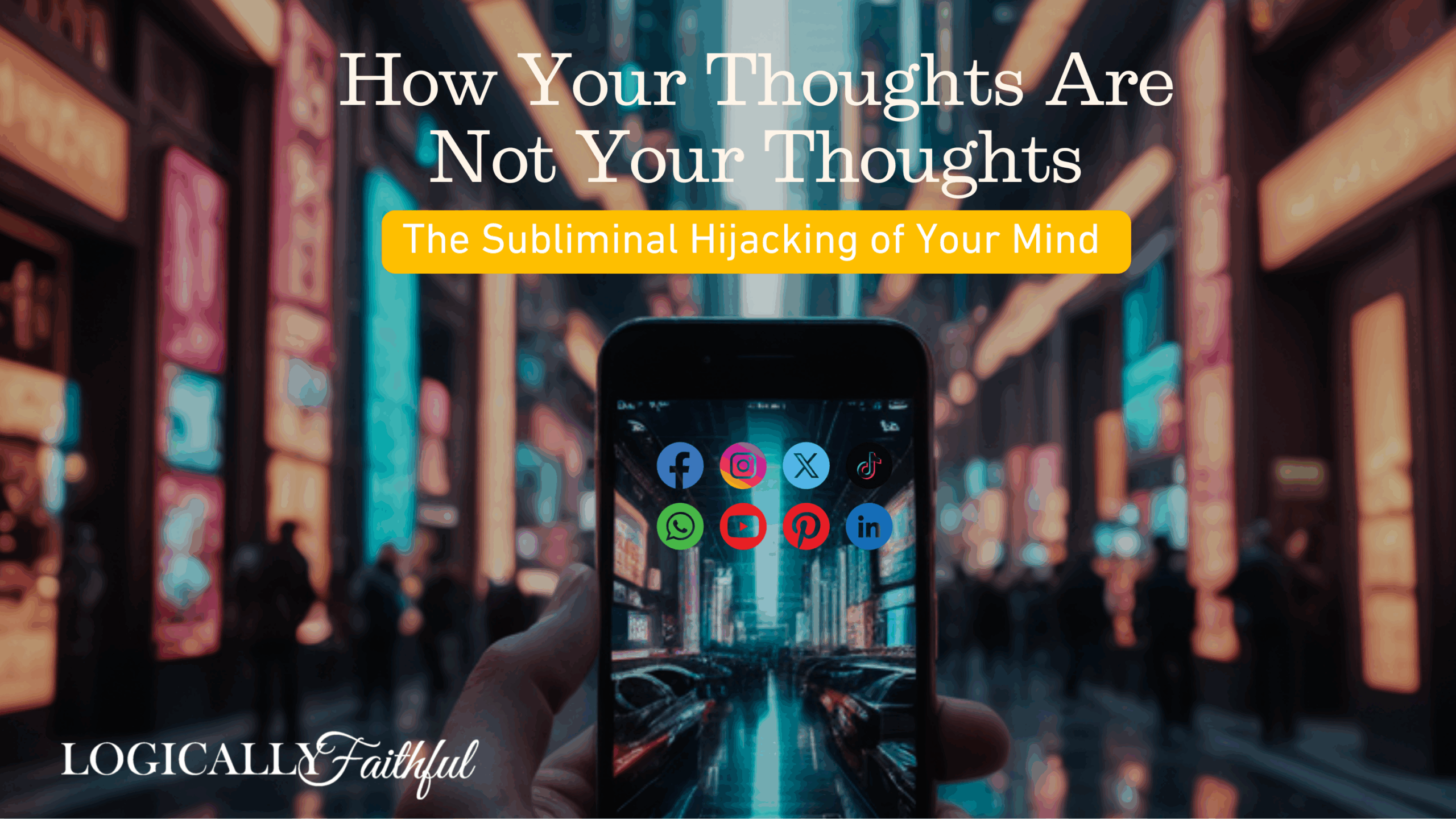
Over time, your thoughts are no longer purely yours. They are co-authored by invisible engineers, ad buyers, political operatives, and even pseudo-religious movements with deep pockets and global ambitions. TikTok, Instagram, Facebook, YouTube, Google — all are competing for the same prize: your attention, your identity, and your trust–and to ultimately to control you and make you think you choose them.
The Illusion of Freedom
The danger is not that these platforms tell you outright what to believe. It’s that they control the raw materials of belief — the inputs from which your mind builds its worldview. They don’t need to lie to you directly. All they have to do is decide what you see first, what you see most often, and what you never see at all.
Imagine living in a city where every street looks open, but invisible gates stop you from turning down half of them. You think you’re exploring freely, but you’re pacing inside a gilded maze. The same happens with information. The routes of thought feel open, but in reality they’ve been silently fenced in.
Evidence of how You are Manipulated
This isn’t speculative paranoia. Robert Epstein, a research psychologist at the American Institute for Behavioral Research and Technology, documented what he calls the “Search Engine Manipulation Effect” (SEME). His peer-reviewed studies show that biased search results can shift undecided voters’ preferences by 20% or more — and up to 80% in certain demographic groups — without their awareness.
During the 2016 U.S. presidential election, Epstein’s team monitored Google search results and concluded that pro-Clinton bias in top results could have shifted “at least 2.6 million” votes toward Hillary Clinton. In Senate testimony, he stressed the danger: such manipulation leaves no paper trail, no record to audit, and no awareness on the part of the manipulated.
Google denies intentionally biasing results, but whether or not intent can be proven, the mechanism exists and the potential is staggering. As James Bowman warns in Is Stupid Making Us Google?, “We are becoming a culture in which remembering is replaced by retrieving, and thinking is replaced by looking up.”
Incurvatus in se
Augustine called this condition incurvatus in se — the soul “curved inward on itself.” It describes the human tendency to become self-referential, to use even the best gifts for our own gratification. The algorithm weaponizes this ancient flaw.
Every click is a vote for the familiar. The system notes it and feeds you more of the same, folding your world tighter and tighter until your intellectual oxygen comes only from within. What was once a weakness of individual character has become a profitable business model.
The result? A generation trained to feed endlessly on its own reflection, convinced that the reflection is reality.
It’s like a chef who secretly spikes every meal with the same addictive seasoning. After a while, your taste buds forget the richness of other flavors, and anything without that seasoning tastes wrong.
Or like a pilot whose navigation system has been slightly off for months — not enough to notice at first, but enough to land them in an entirely different country.
Or like a parasite that can hijack the brain of its host, compelling it to behave against its own survival instincts while making it feel like every choice was its own idea.
The Cost to Freedom of Thought and Speech
Real freedom of thought isn’t simply the ability to form opinions; it’s the ability to form them from a wide and unmanipulated field of ideas. When algorithms decide what enters that field, they can steer not only elections but the shape of public discourse itself.
This is more subtle than censorship. It’s pre-censorship. If you never encounter an idea, you never have the chance to accept or reject it. The Leviathan no longer has to burn books; it simply makes sure the books you most need are never placed on your shelf.
This is why the movement to make schools phone-free is more than a debate about classroom etiquette. In Vermont, banning personal devices during the school day created a rare algorithm-free zone. Students spoke face-to-face, argued without feeds coaching their talking points, and rediscovered the art of unmediated conversation.
Illinois nearly followed suit. These schools are like training gyms for the mind — places where young people can learn to think in their own voice before that voice is permanently shaped by corporate scripts.
The Google Effect: When Memory Outsources Itself
Nicholas Carr famously asked in his 2008 Atlantic essay, Is Google Making Us Stupid?,
“What the Net seems to be doing is chipping away my capacity for concentration and contemplation. My mind now expects to take in information the way the Net distributes it: in a swiftly moving stream of particles.”
Carr wasn’t lamenting ignorance — he was describing a rewiring of attention itself. In his follow-up book The Shallows, he explained that neuroplasticity means our brains adapt to the medium we use. Constant skimming and clicking trains us for shallowness, not depth.
Bowman’s counterpoint, in Is Stupid Making Us Google?, warned that the cultural laziness to think deeply — our demand for instant, bite-sized answers — invites the very dominance Carr fears. As Bowman put it: “Google is not making us stupid; stupidity is making us Google.”
Both men diagnose the same feedback loop: the less we think deeply, the more dependent we become on tools that encourage shallow thinking — which in turn makes deep thought feel harder and rarer.
The Neuroscience of Thought Capture
Neuroscientists warn—though we scarcely listen—that heavy engagement with high-speed, algorithm-driven feeds isn’t merely a habit; it’s a reprogramming. Platforms like TikTok or Instagram aren’t neutral pastimes. They are precision-engineered Skinner boxes, designed to keep you pecking for the next pellet of novelty, the next morsel of outrage or amusement. And like rats in such a box, we adapt—quickly. Neural circuits built for scanning and reacting grow strong. But those for reasoning, for moral discernment, for empathy—the slow, quiet virtues—begin to wither.
Your mind becomes like a camera locked in “burst mode,” firing off snapshots in frantic succession. That’s wonderful if you want fragments. But you cannot take in a landscape like that, cannot behold the contours of a moral argument, cannot hold another human being’s pain in focus long enough to understand it. Reading a serious book, sitting still with grief, wrestling with a complex question—these begin to feel not merely difficult, but unnatural.
And here lies the real danger. This is not simply about “short attention spans.” This is about the very architecture of the soul. We are, as Augustine put it, incurvatus in se—curved in on ourselves—when we let our minds be trained for nothing higher than the next flick of the thumb. The algorithms are happy to assist in that curvature, bending our gaze ever inward toward self-satisfaction and away from truth, beauty, and goodness.
Lewis warned of a similar fate when he spoke of men without chests—creatures clever enough to build empires but too morally stunted to govern themselves. If our capacity for long-term thought and moral reflection atrophies, we will be governed not by reason but by appetite. And appetites, when enthroned, are cruel masters.
A democracy cannot be sustained by citizens trained to react rather than reflect. A marriage cannot flourish between partners who have forgotten how to attend to one another’s words without distraction. A soul cannot grow if its gaze is perpetually yanked from the eternal to the trivial. The real question is not whether we can still think deeply, but whether we will even remember what deep thought feels like—or care that we’ve lost it.
The Collapse of Telos
what we are witnessing is not merely the deterioration of culture—it is the collapse of telos. In classical thought, telos was the end, the goal, the ultimate purpose toward which all things strive. A seed’s telos is to become a tree; a ship’s telos is to reach its harbor. For two millennia, Western civilization understood that humanity, too, has a telos—rooted in the imago Dei, the image of God. That divine image was our compass, pointing to truth, justice, beauty, and human flourishing.
But strip away the theistic framework that gave us this vision, and the compass spins uselessly. In the vacuum left by Christianity’s retreat, purpose is no longer defined by what we were made for, but by what we can be made to do. In the hands of the algorithm, our “purpose” has been reduced to “engagement.” And engagement, stripped of moral direction, will default to the lowest common denominator of the human psyche: outrage, fear, vanity, lust, and distraction.
A civilization that once oriented itself toward God now orients itself toward the dopamine spike. The cathedrals of our age are not built to inspire the soul toward the eternal; they are designed to harvest attention in 15-second bursts. This is not progress—it is a reversal, a reversion to the pagan marketplace where every appetite shouts for dominance and nothing higher than appetite is acknowledged.
The ancients understood that without a guiding telos, the virtues collapse into vices. Courage becomes recklessness. Freedom becomes license. Pleasure becomes addiction. In the absence of God, the modern West has no objective reason why truth should be valued over falsehood, why justice should triumph over power, or why beauty should matter at all. All that remains is preference—and preference is infinitely malleable by those who control the levers of culture.
And so we should not be surprised when truth is sacrificed for virality, when justice is replaced by mob outrage, and when beauty is trivialized into filtered self-advertisement. Without a transcendent end, we no longer even ask whether something is good; we only ask whether it is engaging.
In the Christian vision, telos was not merely an abstract concept. It was a Person—Christ Himself—the Logos in whom all purposes converge. Sever that root, and the branches of civilization wither, no matter how brightly the neon of the algorithm tries to paint them.
How to Push Back: Two Deep Practices
First, rebuild friction into your information diet. Seek out dissenting voices deliberately. Read long-form articles from outlets you disagree with. Subscribe to publications across the spectrum. Create space in your day where your attention is not for sale.
Second, recover analogue sanctuaries. For families, this could be nightly phone-free dinners. For communities, it could mean device-free meetings or public discussions. For schools, it means what Vermont has done: reclaiming spaces where the mind can grow without invisible strings pulling it toward the familiar
The Final Word
A few nights ago, I sat in my brother’s backyard. The air was cool, and a fire pit glowed in the center, sending sparks into the dark like tiny meteors. We cooked together over the flames — real cooking, with hands, knives, fire, and smoke. We sang songs. We prayed. We laughed until our ribs ached. There were no screens. No endless scroll. No subtle compulsion to “capture” the moment because the moment itself was enough. For those few hours, the world of glowing rectangles and algorithmic whispers felt far away, as if we had stepped back into a slower, truer way of being human
So here’s the challenge: do not just think about escaping the Leviathan — practice it. Step away from the machine long enough to remember that you have a mind, a soul, and a voice that do not need permission to exist. Go cook with someone you love. Go sing under the stars. Go pray without streaming it. Go laugh until you can’t breathe. And when you return to your devices, you’ll know exactly what they cannot give you — and you’ll be far less willing to trade it away.
“The mind that is enslaved to its own appetites will soon prefer its chains to its freedom.” — G.K. Chesterton
Neil Postman once warned us that there were two great visions of cultural ruin: George Orwell’s 1984 and Aldous Huxley’s Brave New World. Orwell feared that what we hate would destroy us — the boot stamping on a human face, the pain of overt oppression. Huxley feared that what we love would destroy us — the narcotic of endless pleasure, the soft tyranny of distraction. In the 21st century, we have built a machine that fulfills both prophecies at once: it gives us the illusion of choice while slowly stripping away the capacity to choose. We are not beaten into submission; we are entertained into it.
And unless we step away from the glowing rectangle and back toward the fire pit — toward the reality that God, nature, and history have given us — we will awaken one day to find that we have not only lost our freedom of thought, but also our appetite for it