
“I do not believe in anything that is not physical–I only believe what science tells me is true,” is what a student of mine told me as he came into my office at Olive-Harvey College. But the fact was that he was making a paradoxically illogical statement and embracing a dangerous secular paradigm. For this article, we will address that and ten things we cannot learn from science alone.
When you see water boiling on my stove, you can ask “why is the water boiling?” I can tell you that “rapid vaporization of the liquid is occurring because the heat is causing pressure that is above that of the surroundings.” Or I can say “I am making soup”! One is a scientific answer the other is not. Both are true.
Life is more than just what we can quantify scientifically.
I will attempt to demonstrate that what we can “prove,” that is, physically using the scientific method, is not the only way to arrive at truth. As a philosopher, the question that raises its head almost every semester in my classes is, “There is no right answer in life, therefore, Professor we should focus on the sciences to give us ultimate truth, right?” No. This article is a response to this question and popular myth.
Science (derived from Latin scientia, meaning ‘knowledge’) is a way of looking at and researching the world. I am not knocking science or scientific research! It is necessary and I could not write this article without it. But behind every scientific invention or theory there is a worldview or philosophy that is itself not scientific.
Daniel Dennett said it best,
“There is no such thing as philosophy-free science; there is only science whose philosophical baggage is taken on board without examination.” “Darwin’s Dangerous Idea,” (Simon & Schuster), 1995.
The view called naturalism, (aka scientism or materialism) holds that nothing but the physical world exists. This view is false on many accounts. See my article on the issue here where I address the problems of this worldview (you can also listen to the talk I gave on itunes here.)
The paradox is that if you only believe what is provable by science, which is a strain of naturalism, then you cannot believe even that.
Let’s go back to my student in my office. He said “Professor Sweis, I don’t believe in anything that is not physical.”
“I told him, you don’t believe that.”
He said, “I do.”
I said, “You don’t.”
He said, “Why?”
“Think about it, the very thought you have, “I don’t believe anything that’s not physical” is itself not physical.”
Consciousness, especially self-consciousness is not physical per se. It cannot be quantified on any MRI, CAT scan or computer in the known universe. Is that because our technology is not advanced enough? No. It is because consciousness or thoughts are necessarily not physical. What is physical is what takes up space or volume or can be measured by a third person perspective. Thoughts are necessarily first person and private. They are not physical in the way a virus or microwaves or dogs are where we can measure them. So you believe your thoughts are real. So you don’t believe the thought you had, “I dont believe what is not physical” because it is not physical itself.
He thought for a moment and said, “I suppose I don’t believe it.”
I said, “As a matter of fact, there are a great deal of different things in the world that are not physical that you believe, such as but not limited to love, meaning, morality, justice, logic, literary analysis, etc. These things have results in the physical world, but they are not physical themselves.
Consider, if naturalism is true, then humans are just part of the physical universe, it makes us essentially no different than animals or rocks in an ultimate sense. So when Malaysia Airlines Flight 370 disappeared on March 8, 2014 with 227 special and sacred persons on board, according to naturalism there are just 227 homosapens, or hairless apes, worth as much as rats in the vast scheme of things that went missing.
But that is not true, these 227 missing humans are special children, women, men, fathers, mothers and ladies that are not replaceable–they are beings of infinite worth. Even the United Nations Universal Declaration of Human Rights declares the following: “Whereas recognition of the inherent dignity and of the equal and inalienable rights of all members of the human family is the foundation of freedom, justice and peace in the world.” How can this be if we are not more than other animals and substances?
Naturalism is in error, we are so much more than these bodies and what you see in the mirror.
It is dangerous to assume we are just physical things.
But science is a wonderful gift to make sense of creation and that we have used and are using to make our world a better place.
But science alone does not tell us everything. Scientists do. For now, I will list ten things we cannot prove with science alone.
- Logical Truths: These must be accepted as foundational presuppositions in order for us to engage in any scientific study, so we clearly can’t use science to prove logic. In fact, it is the other way around. We need logic to make sense of science. My wife cannot be pregnant and not pregnant at the same time and same sense. A truth cannot be false at the same time as it is true. If all mothers are women, then every mother we meet must of necessity be a woman. There is no escape from this. These are logical truths that science relies upon.
- Metaphysical Truths: Some truths about the nature of the world (such as whether or not the external world is what we think it is, our free will and ourselves) cannot be determined through the use of the hard sciences. Your personal identity, your sense of self and personhood is not found in your DNA alone.
- Moral and Ethical Truths: Science cannot tell us what is morally virtuous or vile. It tells us what “is.” But it does not tell us what “ought to be” (related to moral judgments). Science can tell you who died, how he died and what way he was killed. But it cannot tell you if he was murdered–it cannot tell you if it was wrong to kill him. Sam Harris and many others tried but failed to do this.
- Scientific Truths: Science itself is based on assumptions that can’t be proven scientifically. Nature is orderly it follows regularity, pattern, and structure–these must be true for any science to work at all. The very foundations for most scientific theories are based on presuppositional, epistemological claims about truth, reality and the nature of the world as we know it. There are laws and equations built in the very foundation of the universe, such as, thermodynamics, electromagnetism, the strong and weak force, and gravity—which most cosmologists tell us were present in the singularity in the very origin of the universe! These are what make science work, but science alone cannot explain these laws without proposing them.
- Mathematical Truths: We cannot know with 100% certainty that the next time we multiply 100 X 100 the answer will always be 10,000. The Pythagorean theorem and other principles help us to understand science . These are mathematical laws that we cannot know will work using science alone. In fact we need math to make sense of science, not the other way around
- Consciousness Truths: Scientific analysis can never tell us what “what it is like” to experience love or hate or betrayal. MRI or CAT scans of our brains will not produce data on this. This is private and personal knowledge that cannot be gained by a scientist. Scientists and scholars call it, Qualia. It is the nature of experience itself that does not lend itself to a scientific third-person analysis. By the way, the idea “I cannot believe anything that is non-physical,” is itself a non-physical thing! This is what we call a contradictory statement.
- Literary Truths. We cannot know by science alone that Mark Twain’s Huckleberry Finn was a more interesting character than Homer’s Agamemnon. Literary truths require analysis, but not the same kind that rocks, organs or comets do.
- Beauty and Musical Truths: We can do an analysis of music and beauty mathematically and physically. We can the Golden Ratio to do an review of Leonardo da Vinci’s art where we investigate the balanced facial features of the Mona Lisa by notions put forth by the ancient Greeks that symmetry and balance are an important ingredient in human judgments of beauty and of musical notes, such as tempo and rhythm and the balance between them. However. the appreciation of that music and beauty takes something other than scientific methodology. Science alone is insufficient to capture this. As a matter of a fact, the more analysis you do of a musical piece or artwork the less beautiful it can become because part of its enjoyment is the wonder in it!
- Forgiveness and Peace. Study science all you want, and you will not be one step closer to finding forgiveness or peace for your sins and the people you hurt with biology or chemistry alone.
- Purpose and Hope. You cannot find the purpose of all of life, and your life in particular with scientific analysis alone. Scientific research can confirm that lives with purpose are more lasting, but it does not tell us what that purpose is.
The bottom line is what William Shakespeare wrote in Hamlet, that “There are more things in heaven and earth, Horatio, Than are dreamt of in your philosophy.” Act 1 scene 5G
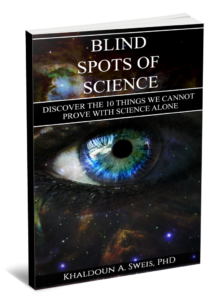 available to you free for just signing up on my webpage. See the link to the bottom right tab –>
Or try this LINK:







Leave a Reply to Keshawn Gibbs Cancel reply