
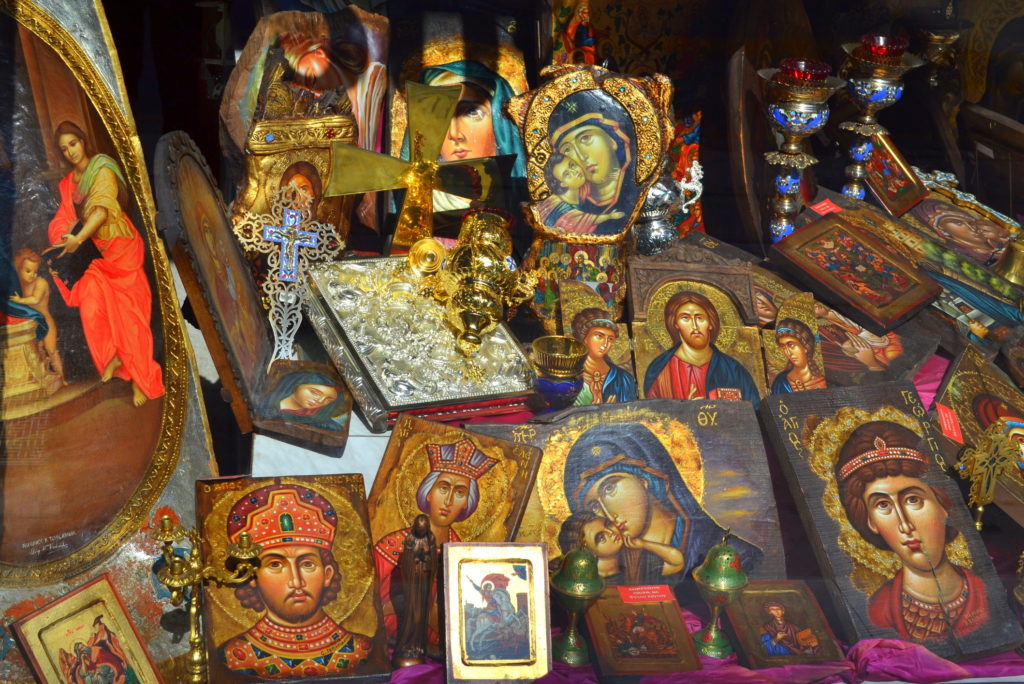
Kissing the dead, that is what I saw happening when I was in Romania a few years ago with my bride. We entered a monastery that had the bones of a saint who had been dead over one hundred years. His skull was sticking out of his glass coffin for parishioners to “draw grace from” by kissing or “venerating” him. My question for this post is, “Is it not a subtle slippery slope from veneration to worship of these dead or of their icons?
The very first commandment is to have no other God nor to worship any other.
One of my dear cousins’s little son was bowing down to an icon, and they got it on film. Many people in the community were praising and giving positive feedback on Facebook. I posted a detailed response saying how I admired the fact that that precious boy was praying, and worshiping, which is what we need to do more of! In Luke 18:6 it says “Jesus called them to him, saying, “Let the children come to me, and do not hinder them, for to such belongs the kingdom of God.”! I also raised concerns about bowing down and worshiping images, even images of saints.
However, for reasons I don’t know nor do I judge, my comment was erased from that board, while those who praised the bowing down were left there. Now this is a common thing that happens no matter what the community it is. If you go against what that community is doing, whether it is a religious one or a gang, whether it is the President’s Cabinet or the Mafia, they will not be happy with you. But that is the price one must pay if he stands up for his convictions, even if it is done in respect and love, they will not like it!
Now to be fair, we must ask our Orthodox brethren why they do bow down in front of and kiss their icons?
The Orthodox Christians claim that they do not worship Icons.
According to the Orthodox Christian Information Center, they claim that they only venerate not worship these icons.
“…For each time that we see their representation in an image, each time, while gazing upon them, we are made to remember the prototypes, we grow to love them more, and we are more induced to worship them by kissing them and by witnessing our veneration (proskenesin), not the true adoration (latreian) which, according to our faith, is proper only to the one divine nature, but in the same way as we venerate the image of the precious and vivifying cross, the holy Gospel and other sacred objects which we honor with incense and candles according to the pious custom of our forefathers. For the honor rendered to the image goes to its prototype, and the person who venerates an Icon venerates the person represented in it. Indeed, such is the teaching of our holy Fathers and the Tradition of the holy catholic Church which propagated the Gospel from one end of the earth to the other.
They site the Seventh Œcumenical Synod, which decreed in its Oros.
One of my well meaning Catholic cousins would not tell certain jokes next to his status of Jesus, as if Jesus was localized near the status of him and not omnipresent. By the way, he had a headless Jesus statue! The head broke off but he did not want to “throw away Jesus.” As you can see how slippery the line gets between veneration and idolatry.
Now what did the great Apostle Peter say when someone bowed down to him? Well let us do something radical as Christians…let’s look in the Bible ? “
But Peter took him up saying, ‘stand up; I myself am also a man.” Acts 10:26 he does the same in acts 14:15.
Even the angels of God refused it when others bowed down to them.
“…No, don’t worship me. I am a servant of God, just like you and your brothers the prophets, as well as all who obey what is written in this scroll. Worship God! ” Rev 22:8-9
Do you think that if the people told The Apostle Peter, “no, we are not worshiping you, we are just venerating you,” that his response would have been different?
He would have directed people toward God again. The same can be said of the Mother of our Lord. If we treated a living person today the same way as they treated the icons of the saints would it be considered blasphemy ? It seems it would. Since the Orthodox claim these saints are alive, not dead, then the same would apply to them.
What we bow down to might easily slip into what we worship if we are not ever watchful and careful. We might build churches around them or even hang them on our home walls thinking that we somehow are right with God and protected from Satan with them without regard to our actions and heart toward God.
There was a time in the biblical history of the chosen people that they took an icon that was a symbol of God’s salvation to the earth and began to misuse it and venerate it to the point of bowing down to it, i.e. worshiping it. (2 Kings 18:4) King Hezekiah had this icon destroyed because devotion was given to it that should have only been given to God. It was not the icon that went wrong, but it was the people. There is no error in having icons, but it is more than an error and even sin to give them them the devotion that should be given to God alone.
Some Orthodox scholars will note that it is not the icon that is given the devotion but the image it represents. What is the difference between this and what the Buddhists say when they mediate in front of a statue of Buddha or the Hindus say when they pray in front of a statue of their gods like Vishnu? How are we different than them as believers in the invisible God who became flesh?
I am not saying that icons are idols, no, what I am saying is they can very easily slip into becoming them right unde r our noses. I fear many already have. Now the issue of Icons is not just for veneration, but also for prayer to them (or the saint painted on them)
What did Jesus say when he was asked how we ought to pray? He began with “Our Father, who art In Heaven…”. The prayer was directed to God. The saints in biblical history prayed to only one being –God who is Jesus Christ. (There is another issue here. What about an Icon of Christ? Is that to be venerated or worshiped?) We pray to Jesus because he is the only mediator between man and God (1 Tim 2:5)
He is the incarnation, 100% man 100% God. Why not pray to others? Well the scriptures tell us he is a jealous God. “I the Lord your God, am a jealous God who will not share your affection with any other.”
When we knell to St. Peter, or St. Paul, we are very close to insulting them in our “veneration” of them. Prayer to saints is seen and done, but is it wise? It is to be done when Christ is God’s mediator for us? Why do we need another mediator?
Why not pray to God? For he is all good beyond what we can image, loves us more than we can dream and hears all our petitions. We would like a rational biblical answer to this. Are icons the determiners of ones spirituality with Christ? Does an icon need to be in my home for me to be a believer? What are the traits of a true believer? Membership? Veneration of Icons? Prayer to Saints? Taking of Communion? Pilgrimage? Schooled in Theology? No.
The Apostle Peter goes on to list some of the traits a true believer should have: love, joy, peace, longsuffering, gentleness, goodness, faith, meekness, temperance (II Peter 1:3-10). What is the ultimate sign that Jesus gave us that we can show people that we really are Christians? “By this shall all men know that ye are my disciples, if ye have love for one another (John 13:55). I am not saying that if a person is ethical that they are thus a believer. No. A believer is one who is born of the spirit of God, repented from their sins and has accepted the eternal Gift that God has given them, forgiveness by the death of his son on the cross, and as evidence of this has the fruits in their life that St. Peter spoke of.
I leave my Orthodox and Evangelical brethren with two things, one question and one comment.
George Kakaletris makes this point, “If professing Christians claim to love God and yet hate one another, no amount of icons in the home (or religious activity) will cause the world to take notice. If anything, the icons (a symbol of religion to the unbelievers) are unfortunately going to become associated with the hate that’s exemplified, and will give the world one more reason to ridicule the church, Christianity and God. ”
Secondly,
“we ought not be iconoclast as much as they should be idoloclasts,”
wisely said Madline L’angle. There are many icons in our owns lives that if we don’t deal with them wisely will also become idols right under our noses. I close with the immortal words of C.S. Lewis:
“He works on us in all sorts of ways. But above all, He works on us through each other: Men are mirrors or ‘carriers’ of Christ to other men. Usually it is those who know Him that bring Him to others. That is why the Church, the whole body of Christians showing him to one another; is so important. It is so easy to think that the church has a lot of different objects-education, building, missions, holding services…the Church exists for no other purpose but to draw men into Christ, to make them little Christs. If they are not doing that, all the cathedrals, clergy, missions, sermons, even the Bible itself, are simply a waste of time. God became man for no other purpose. It is doubtful, you know, whether the whole universe was created for any other reason.”
Finally, in light of this, where does the Eastern Church draw the line so that veneration does not become worship and worship does not lead to relying on icons for grace rather than the biblical stance that it comes from Christ alone?
For the record, I do have an ancient icons of Jesus in my office to remind me that He is my God and witness to others.
In all this, there are men wiser and much more holy than I who disagree with me. That I understand, and write this with much respect and humility.
See this short video on the debate between veneration and worship from the John Ankerberg show.
Although it has a Catholic Priest and Protestant, the basic problem remains and is expressed clearly.
What do you think?










Leave a Reply to Piet Van Assche Cancel reply